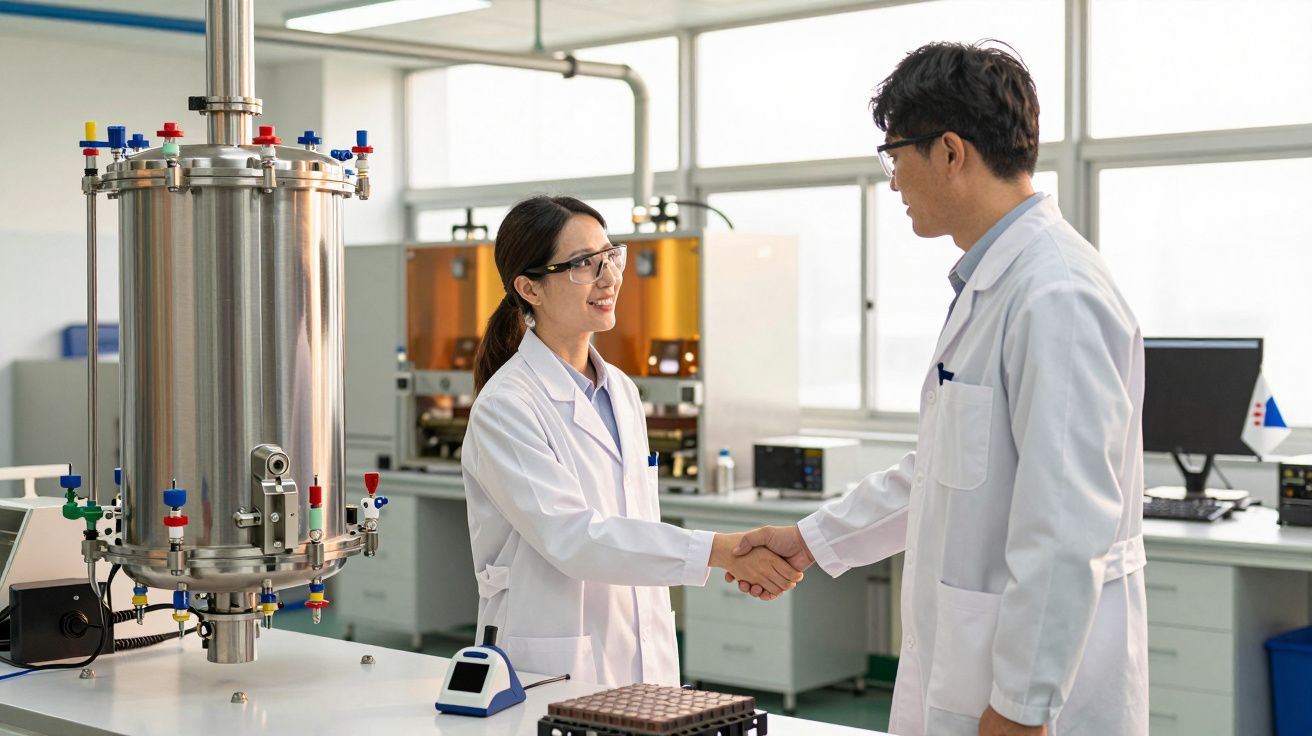
France’s Air Liquide has just spent billions to tighten its grip on that ingredient in South Korea, placing a calculated bet on ultra‑pure gases as a core lever of future industrial power.
Air Liquide’s €2.85 billion bet on South Korea
On January 13, 2026, French industrial gases group Air Liquide confirmed it had completed its acquisition of DIG Airgas in South Korea. The price tag: about €2.85 billion. The target: a company already deeply woven into the country’s advanced manufacturing base.
Air Liquide knows the terrain. The group has operated in South Korea for more than 30 years, supplying medical oxygen and specialty gases for the electronics sector. With DIG Airgas, it shifts gears-from being an important supplier to becoming the dominant player in a highly strategic market.
Air Liquide is not just expanding in Asia; it is turning South Korea into a core hub for its global ultra‑pure gas strategy.
DIG Airgas brings serious industrial heft:
- Around 60 production sites across South Korea
- 220 kilometers of dedicated pipeline networks
- Roughly 550 employees
- 2024 revenue of about €510 million
The company also adds a pipeline of about 20 active industrial projects, giving Air Liquide multi‑year visibility in a market racing to expand capacity in semiconductors, batteries, and high‑tech manufacturing.
Why South Korea matters in the chip and energy race
South Korea sits at the crossroads of several global shifts: digitization, electrification, and the rise of AI. Chips and batteries underpin all three, and both depend heavily on ultra‑pure gases.
By taking control of DIG Airgas, Air Liquide locks in a key position in what many analysts now see as a critical supply‑chain node.
South Korea is already:
- The 4th largest industrial gas market in the world
- The 6th largest industrial economy
- Among the top countries for R&D spending as a share of GDP
Industrial giants such as Samsung, SK Hynix, LG, and Hyundai create dense local ecosystems. Their fabs and gigafactories require continuous flows of ultra‑pure gases, with virtually zero tolerance for interruptions or contamination.
For chip and battery makers, gas purity and reliability now rank alongside electricity and water as non‑negotiable infrastructure.
In this context, Air Liquide is not just a supplier. With the DIG Airgas deal, it becomes a structural partner in South Korea’s industrial planning-embedded in the long‑term expansion of fabs and energy transition projects.
Ultra‑pure gases: the silent backbone of high tech
Behind every smartphone processor or data‑center GPU is a carefully orchestrated sequence of chemical reactions. Ultra‑pure gases are at the heart of that choreography.
How gases make a semiconductor
A modern semiconductor wafer-a thin silicon disk measuring dozens of centimeters across-can be worth several thousand euros. Each wafer goes through hundreds of steps. In many of those steps, a specific gas atmosphere is required:
- Ultra‑pure nitrogen prevents oxidation and keeps surfaces free of contamination.
- Hydrogen supports thin‑film deposition and reduction reactions.
- Rare gases such as argon, neon, or krypton enable precise plasma etching.
A single invisible impurity can ruin entire batches, turning high‑value wafers into scrap. That is why purity levels often exceed 99.9999%, with trace contaminant limits measured in parts per billion-or even parts per trillion.
DIG Airgas built its reputation in South Korea by meeting these standards for leading chipmakers. Air Liquide now inherits that credibility, along with engineering teams used to operating at the limits of current purification technology.
From niche to multi‑billion‑euro market
The ultra‑pure gas segment has moved from a specialist niche to a strategic market in under a decade. Sector studies cited in the original announcement place the global ultra‑pure gas market at about €18 billion in 2024, rising to roughly €18.8 billion in 2025, with a long‑term projection near €28.8 billion by 2035.
Shorter‑term scenarios suggest a value range of €7.5 to €11 billion by 2030 for only the most demanding grades and applications. Growth rests on two main pillars:
- Ever‑smaller chip manufacturing nodes, which require tighter control of every process step
- The energy transition, which increases demand for high‑grade hydrogen and specialty gases for electrolyzers, fuel cells, and certain battery chemistries
Ultra‑pure gases now sit at the intersection of the digital economy and climate policy, touching both AI chips and green hydrogen.
Globally, Air Liquide and Germany‑based Linde dominate this market, thanks to decades of work on purification methods, cryogenic logistics, and large‑scale pipeline distribution systems.
Locking in the Asian electronics triangle
Air Liquide’s move in South Korea fills the final gap in what the group has quietly been building for years: a triangle of gas infrastructure around Asia’s most advanced electronics clusters.
The group already operates major facilities in:
- Japan - a traditional base for high‑end electronics and specialty chemicals
- Taiwan - home to leading foundries and advanced logic chip production
- Mainland China - where vast new fabs and industrial parks continue to rise
South Korea fits naturally into this geography. It adds a dense cluster of memory and logic chip production, alongside emerging battery and hydrogen projects.
| Region | Main focus | Relevance for ultra‑pure gases |
|---|---|---|
| Japan | Specialty electronics, materials | High complexity, diversified demand |
| Taiwan | Advanced logic semiconductors | Extreme purity, stable long‑term contracts |
| South Korea | Memory chips, batteries, EVs | Large volumes, integrated industrial parks |
| Mainland China | Scaled manufacturing, new fabs | Rapid capacity build‑up, push for local supply |
Asia already accounts for more than 60% of global ultra‑pure gas production. That concentration worries policymakers in Europe and North America, who fear a repeat of the recent semiconductor supply crunch. One response has been to secure capacity through ownership stakes and long‑term contracts rather than relying only on imports.
The DIG Airgas acquisition fits squarely into that logic: a French group increases its direct control over strategic supplies in an Asian hub, while strengthening its offering to customers operating across multiple continents.
Economic and geopolitical angles for France
For France, the deal looks like more than a corporate growth story. Air Liquide is one of the country’s flagship industrial groups, and its moves abroad carry weight in trade and technology discussions.
In Asia, French exports tied to industrial equipment and high‑tech inputs have risen sharply in recent years, especially in Chinese regions where Air Liquide already operates major facilities. The South Korean foothold gives French diplomacy a concrete asset when discussing supply‑chain security with partners in Europe and the Indo‑Pacific.
Control over gases that enable chips, batteries, and hydrogen projects is starting to look like a new kind of soft power.
The acquisition also highlights a strategic choice. Rather than trying to outspend the U.S. and Asia on building giant semiconductor foundries, France can position itself in critical inputs-gases, materials, and process technologies that every fab needs, wherever it is located.
What “ultra‑pure” really means
The term “ultra‑pure gas” can sound abstract. In practice, it refers to extremely tight specifications on contaminants such as water vapor, oxygen, hydrocarbons, or metal traces.
Purity is often described using a “nines” notation: for example, 99.9999% purity is called “six nines.” Each additional “9” represents an order of magnitude less contamination. The closer you get to absolute purity, the harder-and more expensive-each step becomes.
Producing such gases involves multiple separation stages, filtration, chemical treatment, and continuous monitoring. The gas then moves through dedicated pipelines or specially treated cylinders to prevent re‑contamination. In major industrial zones, a shutdown or pressure drop in the gas network can stop entire factories within minutes.
Risks, bottlenecks, and scenarios ahead
As chips shrink and climate targets tighten, dependence on ultra‑pure gases will only grow. That creates several risks:
- Concentration risk: With most capacity in Asia, regional shocks could ripple through global supply.
- Price volatility: Energy costs and infrastructure constraints can affect gas pricing and contracts.
- Technological lock‑in: Fabs may commit to a small number of gas suppliers for decades.
One plausible scenario for the 2030s is dual pressure on suppliers like Air Liquide: chipmakers pushing for tighter purity at lower cost, and governments demanding more resilient, lower‑carbon infrastructure. That combination could accelerate investment in local production units, advanced recycling of process gases, and integration with renewable hydrogen projects.
For South Korea, the Air Liquide–DIG Airgas partnership may become a backbone for such developments: more secure gas supply for new fabs, cleaner hydrogen for steel and mobility, and tighter alignment between industrial strategy and energy policy. For France, it strengthens a long‑term position in a market that remains largely invisible to the general public-but central to the next industrial era.



Comments
No comments yet. Be the first to comment!
Leave a Comment