The first time you really notice your head is when it starts hurting.
Not a sharp pain, but that dull, heavy pressure-like your thoughts are wearing a helmet two sizes too small. The screen light is too bright, your jaw is tight, your neck feels like a block of wood.
You rub your temples absentmindedly. Two lazy circles. It helps for three seconds, then the stress comes back-thicker, more stubborn. Your brain is racing, your scalp almost buzzing. You think, “I just need someone to press pause on my head.”
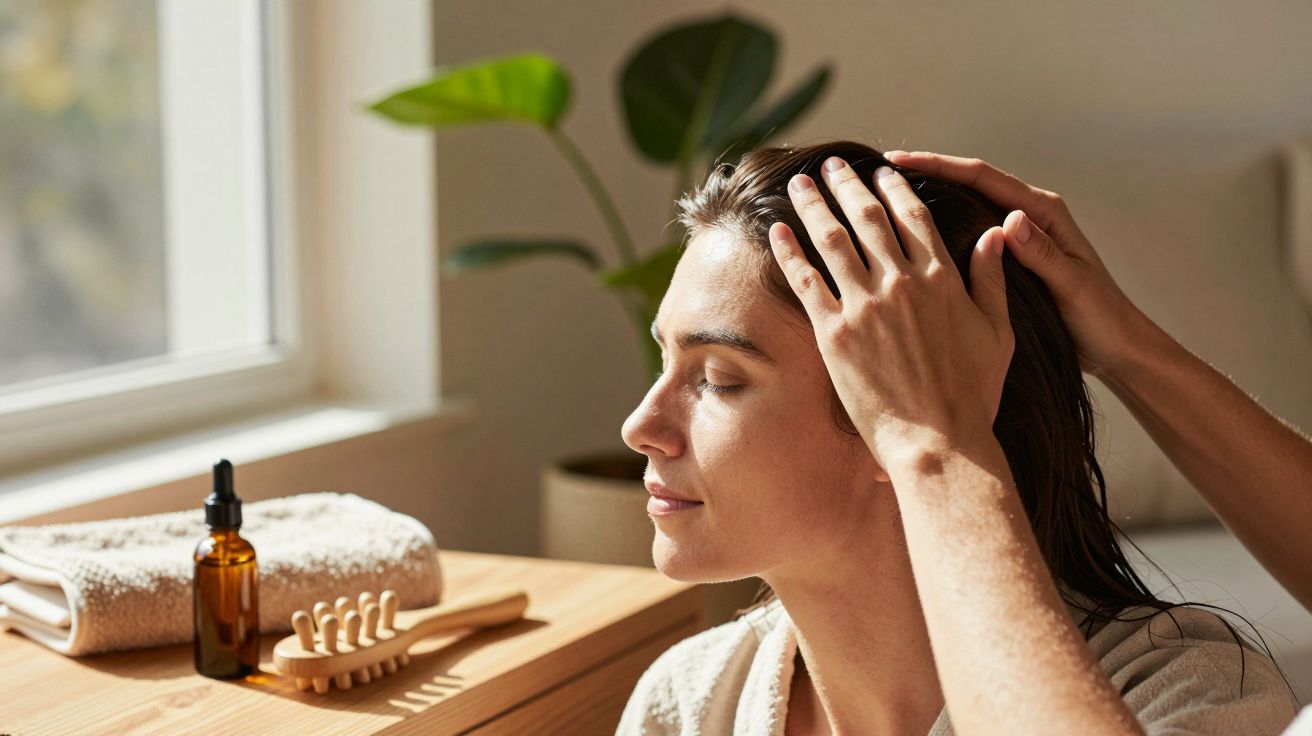
So you close your eyes and try something else. Your fingers sink into your hair, you press, you breathe out. For a brief moment, everything softens, as if someone had opened a window inside your skull.
What if this tiny relief wasn’t an accident?
Why Your Head Carries the Weight of Your Day
Put your hand on your scalp right now and keep it there for five seconds. You might feel warmth, or a surprising stiffness under your fingertips. The skull looks rigid, but the tissues covering it are full of micro-tensions no one talks about.
Hours of screens, teeth clenched in silence, shoulders hunched up near your ears. All of that ends up parked in the muscles around your head. We talk about “mental load,” but your scalp, jaw, and neck literally carry the story.
That’s why a simple cranial massage can feel almost disproportionately good. You’re not imagining it: your nervous system gets the message.
On a rush-hour subway train in Paris, a young woman leans her head against the window, eyes closed. Her thumb presses slowly into the hollow between her eyebrow and her temple. She doesn’t look serene-just exhausted. Still, her shoulders drop a notch.
We’ve all had that moment where we instinctively touch our forehead or rub the back of our neck after a long call. It’s a survival reflex more than a wellness routine. Your body is quietly trying to self-soothe-like a built-in first-aid kit you forgot you had.
One study by a Japanese research team looked at twelve minutes of gentle scalp massage per day over a few weeks. Participants not only felt less tense, but their stress markers in saliva also went down. Small gestures, big impact-even on paper.
The logic is simple. Your scalp is full of blood vessels and nerve endings connected to the rest of your body, including your face, neck, and shoulders. When you stimulate these zones, you boost circulation, send “it’s safe” signals to your brain, and often release muscles you didn’t even realize were clenched.
Cranial massage can also work with your breathing rhythm: press, release, exhale. The body loves rhythm-it gives it something to follow. That’s why a few regular movements can calm your inner storm faster than another doomscrolling session.
Once you understand that your head isn’t just a hard shell but a living, responsive landscape, self-massage stops feeling like a “spa” thing and starts feeling like basic hygiene.
The Simple At-Home Self-Massage That Resets Your Head
Start with the easiest entry point: the base of your skull. Place your thumbs on the two small hollows where your neck meets the bone, just behind the ears. Let the weight of your head sink slightly into your thumbs and breathe out slowly.
Hold for six to eight seconds, then release. Repeat three times. Nothing fancy-just pressure and breath. This area is a crossroads for tension and can send a wave of relaxation down your spine.
Then move your fingertips to your scalp and “walk” them from your forehead to the back of your head. Make tiny circles, like you’re shampooing-but slower, and with more intention.
Next: temples and jaw. Place two fingers on each temple, just above the cheekbones. Draw small circles, gradually moving toward your hairline. Let your jaw hang slightly open while you do this, even if it feels a bit strange. It gives facial muscles you usually hold tight in silence a chance to let go.
Slide down in front of your ears and gently pinch the area where the upper and lower jaw meet. Two or three light squeezes, then release. This is where a lot of nighttime grinding and daytime stress like to hide.
If your shoulders start to burn, drop your elbows for a moment and reset. You’re not here to work out your arms-you’re here to send a clear “you can relax now” message to your whole system.
The most common mistake with self-massage is being too stiff, too fast, or too ambitious. We tend to attack our heads the way we attack our to-do lists: in a hurry. Your scalp doesn’t need that.
Go slower than you think you should. Use enough pressure to feel something, but not to chase pain. A good rule: you should be able to keep breathing normally while you press. If you catch yourself holding your breath, ease up.
Let’s be honest: nobody really does this every single day. So aim for realistic micro-rituals. Two minutes before a meeting, three minutes before sleep, one minute in the bathroom between two notifications. The body responds more to repetition than to heroic one-off efforts.
Some people feel a wave of emotion while massaging their head-tears, laughter, or just a big sigh. You’re touching the interface between your brain and your body; things can shift.
“The scalp is often the last place we think of when we talk about stress, and yet it’s one of the fastest ways to tell the nervous system: you’re safe, you can let go,” explains a London-based massage therapist who sees burned-out office workers all week long.
To help you remember the sequence, keep this simple framework in mind:
- Base of the skull: thumb pressure and breathing
- Entire scalp: slow “shampoo” circles from front to back
- Temples and jaw: tiny circles, relaxed jaw, light pinches
You can adapt the duration to your day. One round in 90 seconds during a coffee break, three rounds in ten minutes on a Sunday evening. The point isn’t perfection-it’s contact. A quiet, almost private conversation with your own head.
Let Your Fingers Become Your Daily Reset Button
There’s something disarming about how low-tech this is. No app, no subscription, no device humming on your forehead. Just your hands, your scalp, and a small slice of attention reclaimed from the noise.
Picture your day cut into chapters. Before opening your inbox: thirty seconds on your temples. After a tense call: thumb pressure at the base of the skull. Before sleep: slow circles across your whole scalp, lights low. These small “cuts” in the narrative interrupt the continuous stress soundtrack.
Many people try cranial self-massage once, feel immediate relief, then forget about it for weeks. The real benefit comes from repetition-not as a strict routine, but as a reflex that gradually replaces other habits.
Imagine if, instead of instinctively grabbing your phone in a stressful moment, your first move was to literally reach for your own head. The change in your evenings, your migraines, your sleep, even your mood might not be dramatic overnight. But layer by layer, the armor around your thoughts starts to crack.
Your head will still feel full, your life will still be busy, and your calendar will still be a bit absurd. But your fingers will know what to do when the pressure rises.
| Key Point | Detail | Why It Matters to You |
|---|---|---|
| Fast relief | A few minutes of cranial massage can ease the heavy-head feeling. | A practical tool to calm stress without equipment or appointments. |
| Simple moves | Three areas to target: base of the skull, scalp, temples and jaw. | Easy to remember and repeat at home. |
| Flexible ritual | Fits into 1, 5, or 10 minutes depending on the day. | Works in a busy schedule without adding another obligation. |
FAQ
- How often should I do a cranial self-massage to feel a difference? You can feel relief from the first session, but doing it 3–4 times a week helps your body learn the pathway to relaxation. Even short, regular sessions work better than a long massage once a month.
- Can cranial massage help with tension headaches? It won’t replace medical treatment, but it can reduce muscle tension around the neck, scalp, and jaw, which often plays a role in tension headaches. If pain is frequent or intense, talk to a healthcare professional before relying only on self-massage.
- Is it safe to massage my head if I have migraines? Some people find gentle touch soothing; others are more sensitive during an attack. Start very softly-ideally between attacks-and stop if the pain gets worse. If you’re unsure, ask your doctor what’s appropriate for your situation.
- Do I need oil or a special product for cranial self-massage? No product is required. Dry massage works well. If you enjoy the ritual, you can add a drop of light oil at the hairline or massage your scalp before washing your hair, but it’s optional.
- What if I don’t feel anything when I massage my scalp? Some people are so used to tension that relaxation feels unfamiliar at first. Go slowly, focus on your breathing, and try again on different days. Sensations often become clearer as your nervous system starts to trust the process.




Comments
No comments yet. Be the first to comment!
Leave a Comment