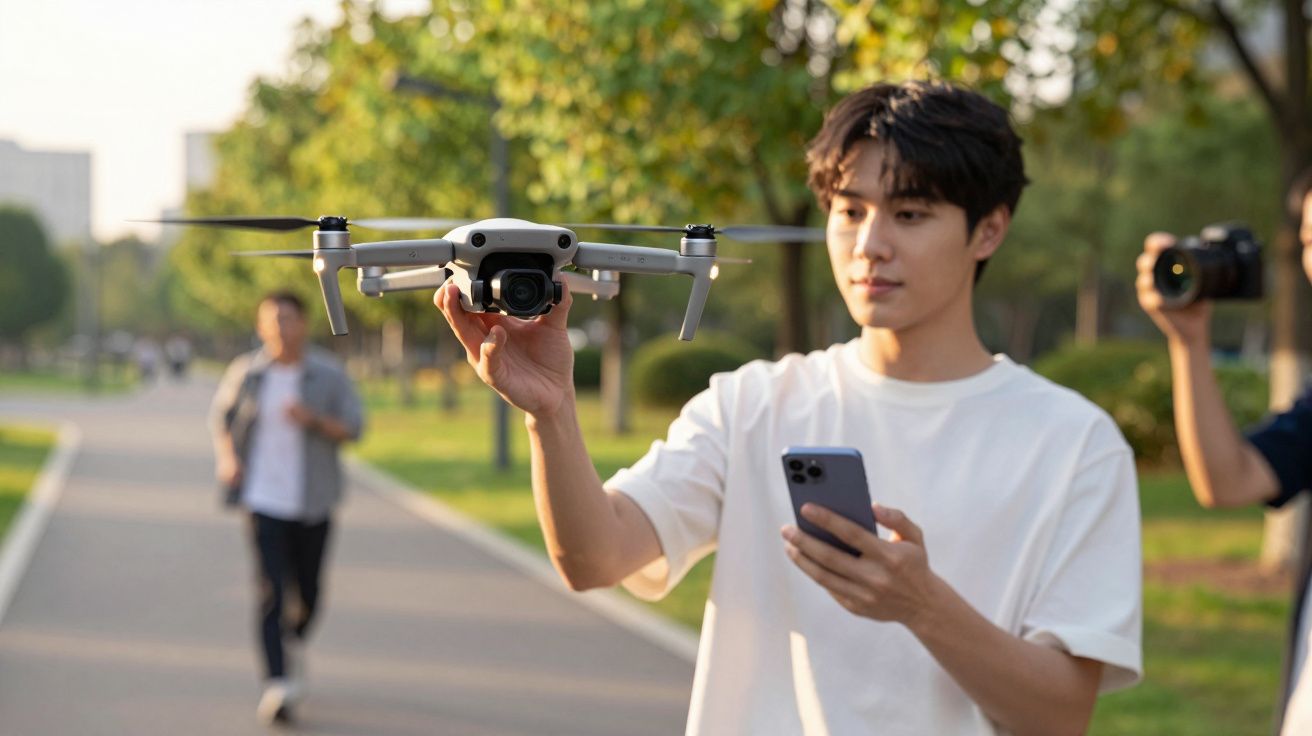
DJI’s new Neo 2 drone is designed for people who want smooth aerial video without worrying about joysticks, complicated apps, or piloting skills. It does this by responding to simple gestures and voice commands.
A palm-sized drone that listens to you
The DJI Neo 2 is a small, 151-gram drone that fits in the palm of your hand, yet it includes features usually reserved for larger models. It’s aimed at beginners and casual creators who care more about the footage than flight technique.
Instead of relying on a dedicated controller, the Neo 2 can be launched, positioned, and directed with gestures or voice. Wave your hand to move it, signal it to start recording, or tell it to follow you. The idea is that the drone handles the flying while you focus on what’s in the frame.
The Neo 2 is built so that anyone with a smartphone and ten minutes of curiosity can get usable aerial shots.
This second-generation model follows the original Neo released about a year earlier. At first glance they look similar, but the internals have changed. The price has changed, too: from €199 for the previous version to €239 for the Neo 2, with DJI saying the upgrades justify the higher cost.
Smarter obstacle avoidance with lidar and infrared
To keep a tiny drone safe, sensing matters as much as speed. The Neo 2 adds a lidar module and an infrared sensor dedicated to obstacle detection. Together, they improve awareness in front of and below the drone.
Lidar sends out pulses of light and measures how long they take to return. That lets the Neo 2 estimate the distance to objects-like walls or trees-and adjust its path. The infrared sensor helps with precise hovering and low-altitude stability, especially indoors or over uneven surfaces.
Lidar and infrared give this toy-like drone capabilities that, a few years ago, belonged to much bulkier aircraft.
These protections matter most when the drone is flying itself using tracking modes or hand gestures. With more reliable obstacle detection, the risk of a beginner crashing the drone into a branch while filming a quick social clip is reduced, though not eliminated.
A camera built for social-first creators
DJI keeps the same 1/2-inch, 12-megapixel sensor as the first Neo, but improves how it’s used. The camera now sits on a two-axis stabilized gimbal instead of a single-axis one, reducing shake and keeping horizons more level.
The lens is equivalent to a 16.5 mm focal length with an f/2.2 aperture. That focal length is wide enough to capture your full body at arm’s length, or to take in a landscape without needing to back up too far.
Video records in 4K, providing enough detail for cropping and reframing for different platforms. For creators who mainly post to TikTok, Instagram Reels, or YouTube Shorts, the Neo 2 can shoot directly in vertical format, avoiding awkward editing or rotation later.
Key camera and flight specs
- Sensor: 1/2-inch, 12 MP
- Lens: 16.5 mm equivalent, f/2.2
- Stabilization: 2-axis gimbal
- Video: up to 4K resolution
- Weight: 151 g
- Top speed: 44 km/h
- Advertised flight time: 19 minutes
DJI claims the Neo 2 can fly for up to 19 minutes per battery under ideal conditions. Real-world use-with wind, frequent maneuvers, and tracking-usually reduces that number, but endurance is still enough for several short clips or a quick photo session.
QuickShots and tracking: flying on autopilot
Like DJI’s larger consumer drones, the Neo 2 includes preset flight routines called QuickShots. These are automated moves that combine camera motion and drone movement to create polished clips without much skill or setup.
For example, the drone can lock onto you, then pull away in a controlled arc while climbing for a cinematic reveal. Another mode might circle a subject while keeping it centered in the frame-something that’s surprisingly difficult to do manually for a new pilot.
Pre-programmed flight modes turn complex piloting patterns into one-tap tricks, helping beginners get footage that looks edited even when it isn’t.
The Neo 2 is also more agile than its predecessor, reaching speeds up to 44 km/h. That makes it suitable for tracking a cyclist, runner, or someone on an electric scooter, as long as the area is clear and the operator follows local rules.
Gesture control, smartphone app, and optional controller
While gesture and voice control are the headline features, DJI hasn’t removed traditional options. The Neo 2 can still be flown using a smartphone app, which adds finer control over camera settings, flight paths, and reviewing media.
For people who want more precise maneuvering, the drone is also sold in a Fly More Combo that includes a physical controller (the DJI RC-N3) and three batteries. This bundle costs €399, compared with €239 for the standalone drone.
| Package | Contents | Price (Europe) |
|---|---|---|
| Standard Neo 2 | Drone, single battery, basic accessories | €239 |
| Neo 2 Fly More Combo | Drone, DJI RC-N3 controller, three batteries, extras | €399 |
Which one makes sense depends on what you plan to film. If you mainly want quick clips of friends and family at short range, the basic kit may be enough. If you want to follow moving subjects or shoot longer sessions, the combo with extra batteries and a controller will feel far less limiting.
Regulation: small drone, real rules
The Neo 2 weighs 151 g, placing it in the C0 category under European regulations. That provides more flexibility than heavier drones, but pilots still have responsibilities.
Users must register the drone on the AlphaTango platform and complete a free online certification before flying. Flights are limited to the “Open A1” category, which generally allows flying near people but not directly over crowds, and always requires respecting privacy and local restrictions.
Even a palm-sized aircraft is treated as an aircraft by regulators: registration, training, and basic safety rules still apply.
In the UK and U.S., similar rules apply, though categories and registration systems differ. Owners are typically required to register devices over a certain weight, follow altitude limits, maintain line of sight, and avoid restricted areas such as airports or sensitive sites. Gesture-controlled flight does not remove those responsibilities.
What “4K,” lidar, and autonomy actually mean
For anyone new to drones and cameras, the terminology can feel dense. Three terms matter most for a product like this: 4K, lidar, and flight autonomy.
“4K” refers to image resolution-about 3,840 by 2,160 pixels. Compared to Full HD, that’s roughly four times as much detail. On a phone screen, the difference isn’t always dramatic, but the extra resolution helps when cropping, stabilizing, or pulling still images from video.
Lidar, as used here, doesn’t create a detailed 3D map like what you’d see in a self-driving car. On a small drone, it’s mainly about quickly and reliably estimating distance to nearby obstacles so the autopilot can react before a collision.
“Autonomy” has two layers: battery life and automated behavior. Battery autonomy is the 19-minute figure describing how long the drone can stay airborne. Behavioral autonomy is its ability to manage itself through tracking, obstacle avoidance, and preset modes. The Neo 2 improves the second more than the first.
Real-life scenarios and risks to keep in mind
Imagine a weekend cyclist who wants to record a ride. With the Neo 2, they could set the drone to follow mode, launch it from a turnout, and let it track them along a quiet path, capturing smooth 4K footage without needing a separate camera operator. A social media creator might use it like a moving tripod while talking to camera, switching between vertical and horizontal formats depending on the platform.
There are risks. Gesture controls can be misread, especially in low light, harsh backlighting, or crowded areas. Tracking modes may struggle if the subject is briefly blocked by trees, buildings, or other people. Battery warnings can be ignored in the excitement of filming, leading to forced landings in inconvenient spots.
To reduce these issues, users should practice gestures in a safe area, start in low-risk environments, and monitor on-screen telemetry when using the app. Extra batteries from the Fly More kit also help avoid pushing a nearly depleted battery “just for one more shot.”
Used thoughtfully, the Neo 2 lowers the barrier to creating aerial content. It combines lidar, dual-axis stabilization, and voice-and-gesture control in a miniature package aimed squarely at people who care more about the videos they share than the aircraft they fly.
Comments
No comments yet. Be the first to comment!
Leave a Comment