In a corner of southern Mongolia where dust storms dominate the horizon, a quiet drama of survival unfolded.
Far from cities, in a desert that swings from brutal cold to extreme heat, a small team set up cameras hoping to catch a glimpse of a ghostlike bear. What those cameras ultimately recorded went far beyond a simple wildlife sighting, pointing to the fragile future of an animal that almost no one will ever see in person.
The Ghost of the Gobi Steps Into the Frame
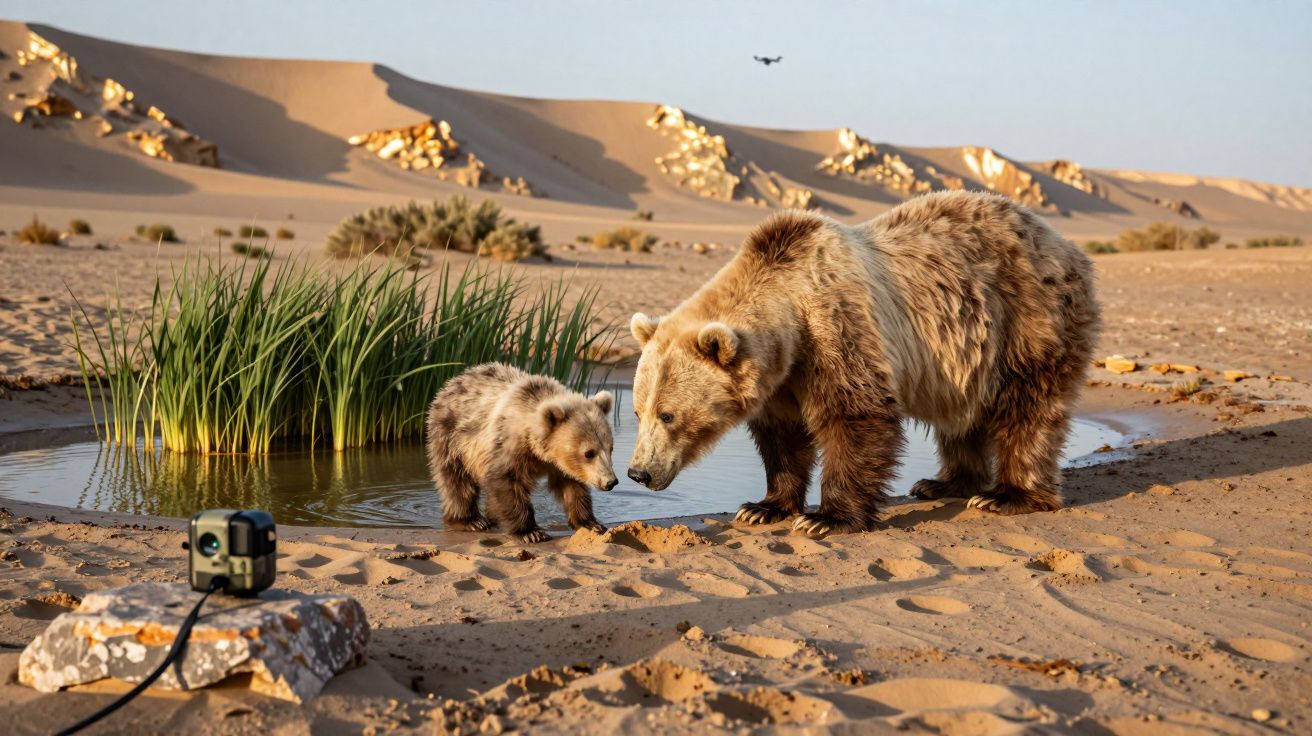
In early August 2025, remotely triggered cameras hidden in the Gobi Desert captured what many conservationists had begun to doubt they would ever see again. A female Gobi bear-known locally as the Mazaalai-walked past a rocky outcrop in the half-light of dawn. Seconds later, a smaller shape rushed into view, hurrying to keep up. It was a cub.
The footage, recorded in southern Mongolia, shows a species balanced on the thinnest possible line between survival and extinction. Fewer than 40 Gobi bears are believed to remain, scattered across a handful of oases within the Great Gobi Strictly Protected Area. Most people, including many Mongolians, will never encounter one in the wild.
The appearance of a single cub suggests that, for now, this critically small population can still reproduce in the wild.
The images were captured by a small expedition working on the series The Wild Ones, produced for a global streaming platform. Their goal was not only to film striking scenes, but also to provide fresh scientific data for Mongolian authorities and international experts desperate for signs of new life in this shrinking population.
A Bear Shaped by an Unforgiving Desert
The Gobi bear is not a separate species, but a distinctive desert-adapted form of brown bear. Over generations, it has become smaller, its coat has grown lighter, and its diet has shifted to cope with a place that seems almost designed to kill large mammals.
In southwestern Mongolia, winter temperatures can plunge to -40°C, while summer heat climbs beyond 40°C. Waterholes can lie more than 160 kilometers apart. Sandstorms strip vegetation, and years of drought can erase entire meadows in a single season.
In this setting, the Gobi bear’s lifestyle resembles that of a cautious desert antelope more than a forest-dwelling omnivore. It feeds mainly on sparse plants: wild rhubarb, tough desert grasses, and pungent wild onions that push through gravel and sand. Animal protein plays only a small role in its diet-an obvious contrast to its more meat-eating relatives in forests and mountains.
- Local name: Mazaalai
- Taxonomic status: Desert form of brown bear
- Estimated population: Fewer than 40 individuals
- Habitat: Oases and dry valleys in the Great Gobi Protected Area
- Main diet: Wild rhubarb, grasses, bulbs, roots, and occasional insects
Where most bears follow rivers and forests, the Gobi bear follows faint green lines on a map, each marking a rare source of water.
This extreme specialization makes the Mazaalai uniquely suited to its environment-but also dangerously vulnerable to any shift in climate or land use. A dried-up spring or a single severe winter can wipe out several bears at once.
Cameras, Drones, and Patience in a Hostile Landscape
Tracking such an elusive animal through traditional fieldwork would take years. The Wild Ones team tried a different approach: saturating the landscape with remote cameras and sensors built to withstand sand, ice, and intense heat. Over several weeks, they installed more than 350 remotely controlled cameras, thermal detectors, and long-range drones guided by satellite imagery.
Each device had to operate silently, with minimal human scent and no bright LEDs, to avoid driving bears away from vital waterholes. Field teams worked at night and early morning, often traveling long distances in off-road vehicles just to swap batteries and memory cards before the heat became dangerous for people as well.
For days, the footage showed only foxes, wild asses, argali sheep, and the occasional camel wandering alone across the gravel plains. Then a nighttime sequence revealed a stocky shape at a spring, its pale fur standing out against dark stones. Later, daylight cameras captured the same bear climbing a slope-followed by the unmistakable wobbling run of a cub.
The technology didn’t just document a rare species; it showed that a new generation is still trying to carve out a place in the desert.
The material is now feeding into a broader conservation effort. The team plans to submit key segments to UNESCO and Mongolian authorities as evidence supporting stronger protections for the bear and its oases.
Why One Cub Matters Far Beyond Mongolia
A single cub may not sound like major news next to global crises, but for a species with fewer than 40 individuals left, every birth matters. That cub represents a small victory against three overlapping threats: climate change, habitat degradation, and genetic isolation.
Climate Pressure on Desert Oases
The Gobi’s scattered springs depend on snowmelt and shallow groundwater. Warmer winters, reduced snowfall, and longer dry spells are already affecting these fragile systems. When an oasis dries up, surrounding vegetation collapses. A bear that once traveled between two springs must go farther to find food and water, burning precious energy and risking starvation.
Scientists studying the region describe a slow tightening of the ecological noose. Fewer plants mean less cover, more heat stress, and less food for rodents and insects that could supplement the bear’s diet. The cub filmed this year will need those plants to still be there in five, ten, and fifteen years.
Genetic Bottlenecks and Isolation
With such a tiny population, genetic diversity is already dangerously low. In small groups, inbreeding can increase disease risk and reduce fertility. New births, like the cub on camera, help maintain numbers but do not solve the underlying genetic problem.
Researchers are now debating possible measures, including carefully managed translocations of brown bears from other regions. The idea would be to introduce new genes while preserving the Mazaalai’s unique desert adaptations. Any such move raises difficult questions about identity, genetic “purity,” and the practical reality of moving large carnivores into a delicate ecosystem.
| Threat | Direct Impact on Gobi Bears |
|---|---|
| Climate warming | Drier springs, reduced plant growth, longer distances between safe water points |
| Human disturbance | Competition for water with livestock, noise, potential poaching risk |
| Genetic isolation | Higher risk of disease, lower reproductive success, reduced adaptability |
Filming Without Disturbing a Species on the Edge
The Wild Ones project uses what the team calls “non-intrusive observation.” That means no baiting, no close vehicle tracking, and no direct interference with the bears’ routes to water or shelter. Cameras operate in low-light or infrared modes to avoid flashes, and drones stay high enough to blend into the wind noise.
This approach reflects a shift in modern wildlife filmmaking. Spectacular, close, emotionally powerful shots still matter to audiences, but the methods used to obtain them are now scrutinized more closely by scientists and viewers alike. For critically endangered species, poorly managed filming can be the final push that forces stressed animals away from the last livable patches.
Show, don’t scare; record, don’t redirect behavior-these are becoming baseline rules for filming species on the edge.
The footage of the Gobi bear and her cub shows how patience and distance can deliver powerful images without forcing animals into staged encounters.
What This Means for Future Conservation on the Ground
Renewed attention on the Mazaalai is already fueling new discussions in Mongolia and beyond. Local rangers-who know the desert intimately-have argued for better funding and equipment for years. International NGOs see the bear as a powerful symbol of climate adaptation in drylands, a topic often overshadowed by stories about polar ice.
Several practical ideas have gained momentum in workshops and policy discussions:
- Securing and restoring natural springs, using low-impact engineering to stabilize water sources.
- Limiting livestock access to key oases through seasonal grazing rules and agreements with herding communities.
- Expanding monitoring with more camera traps and noninvasive genetic sampling from hair and scat.
- Establishing long-term funding mechanisms tied to international recognition of the Great Gobi Protected Area.
These measures require cooperation among desert herders, scientists, rangers, and government officials. The bear’s survival is directly tied to local livelihoods, because the same water and green patches sustain goats, sheep, and camels. Any protection plan must treat herders as partners, not obstacles.
How This Rare Bear Connects to Your Daily Life
At first glance, a pale bear in a distant desert may seem far removed from the busy streets of London, New York, or Los Angeles. But its struggle is part of the same story driving heat waves, crop failures, and water shortages worldwide. The Gobi bear lives where resilience is tested first. Its fate offers an early signal of how life on a hotter, drier planet might cope-or fail.
For readers who want to learn more, the Mazaalai can be a starting point for exploring other desert survivors: saiga antelopes in Central Asia, Arabian oryx on the Arabian Peninsula, or desert tortoises in the American Southwest. Each species shows a different strategy for living with very little water and intense heat. Comparing them can help students and enthusiasts better understand which conservation tactics actually work under pressure.
The next time satellite-guided drones sweep over the Gobi, researchers hope they will still find the faint tracks of that mother bear and her cub pressed into the dust beside a rare pool of water. Their continued presence would mean that, against the odds, this harsh landscape has not yet gone silent.





Comments
No comments yet. Be the first to comment!
Leave a Comment