A buried figure, sealed in stone for millennia, is now forcing archaeologists to question what truly came first: faith, farming, or cities.
At a windswept ridge in southeastern Turkey, a single human-shaped statue-secretly built into a stone wall 12,000 years ago-is pushing researchers to rethink how complex beliefs, architecture, and collective memory first took root.
A quiet find in a noisy archaeological hotspot
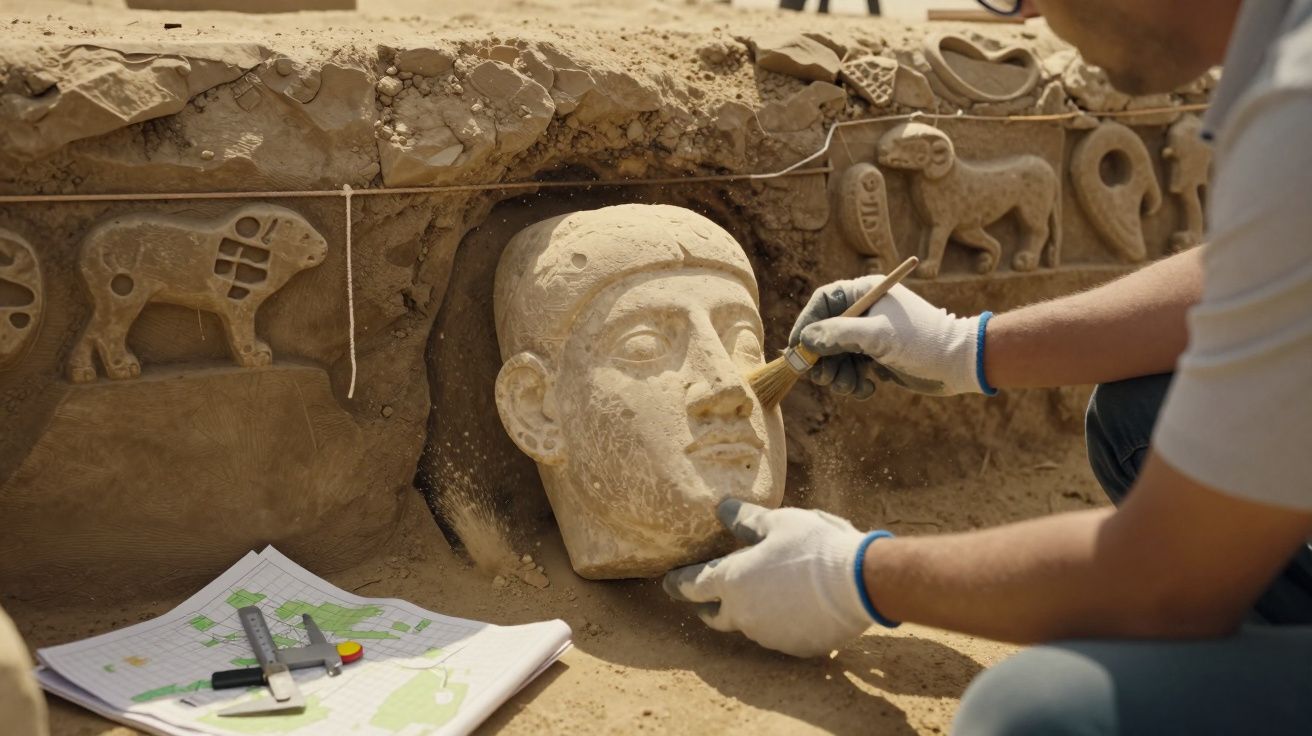
The statue surfaced at Göbekli Tepe, a hilltop site about 9 miles from the city of Şanlıurfa, where circular stone enclosures already challenged the classic story of civilization. Excavations led by Professor Necmi Karul from Istanbul University uncovered the figure placed horizontally into a cavity in a Neolithic wall.
To a passerby, it would have looked like nothing more than another stone block. To the excavation team, the careful insertion signaled a precise, intentional gesture. The statue did not end up there by chance. It was built into the fabric of the wall as part of the architecture.
This was not just a sculpture placed in a sanctuary. The wall itself became a container for meaning, memory, and ritual.
The discovery is part of the Taş Tepeler (“Stone Hills”) project, a major scientific initiative spanning ten early Neolithic sites in the region. Thirty-six institutions and roughly 220 researchers work together, using methods ranging from traditional stratigraphy to geomagnetic surveys and high-resolution photographic documentation.
Conservation teams secured the statue as soon as it appeared. Detailed images remain unreleased while specialists stabilize the stone and remove hardened sediments, which may conceal pigments, tool marks, or inscriptions. Turkey’s Ministry of Culture and Tourism oversees the work, aware that a single object from Göbekli Tepe can shift debates far beyond archaeology.
A rare human face in a world of animals and symbols
Göbekli Tepe is known for monumental T-shaped pillars carved with animals-foxes, snakes, wild boar, birds of prey. Human representations do exist, but they are usually abstract forms, partial bodies, or stylized features. A complete human figure, fully integrated into the architecture, stands out sharply from the site’s usual visual language.
The newly found statue appears to date to between 9600 and 8800 BCE, the Pre-Pottery Neolithic A (PPNA). At that time, communities in the Fertile Crescent still lived mainly by hunting and gathering, while beginning to adopt more permanent gathering places. They did not yet use ceramics and were only starting to manage wild herds.
A full human figure in this context does more than decorate a wall. It suggests that people, ancestors, or imagined beings held a central place in the stories these communities told about themselves.
Researchers already knew that other sites in the Taş Tepeler region, such as Karahantepe, contain partial human figures carved into stone. But a statue deliberately sealed inside a wall cavity sends a different message. Its horizontal placement may signal a “laid to rest” gesture-entombment within architecture rather than burial in soil.
What the style of the statue could reveal
Specialists are now examining every visible detail: proportions, posture, and the treatment of the face, hands, and feet. They are comparing the piece with other Neolithic figures across the region, from stone heads at Jerf el Ahmar in Syria to plastered skulls in the Jordan Valley.
- Pronounced facial features could suggest a specific individual or ancestor.
- Neutral or simplified traits may point to an archetype or mythical figure.
- Tool marks and finishing techniques can help date different carving phases.
- Traces of pigment could indicate ritual repainting over time.
Each of these elements feeds into a larger question: did early settled groups first imagine their gods and heroes as animals, or did human figures hold a central role from the beginning-only to fade later behind more abstract motifs?
A building that behaves like a ritual object
One striking feature of Göbekli Tepe is the absence of domestic architecture. Archaeologists have not found ovens, storage rooms, or ordinary houses. Instead, they see a cluster of monumental stone circles-some over 65 feet across-where towering T-pillars can weigh more than 20 tons.
Many researchers now believe people traveled to this hill for gatherings that combined feasting, ceremony, and negotiation. The structures acted like stage sets, shaping how participants moved, stood, and looked.
By nesting a human statue inside the wall, the builders turned bare stone into something closer to a living body, with hidden organs and layered meanings.
Recent restoration work on the largest of these enclosures, known as Structure C, used a mortar mixed with goat hair, a technique reconstructed from Neolithic evidence. Engineers repositioned pillars, reinforced peripheral walls, and mapped underground features using geophysical methods. This careful reconstruction gives archaeologists a better sense of how sound, light, and movement may have shaped experiences inside the enclosures.
Architecture as a script for belief
When walls are treated as more than barriers and roofs as more than shelter, buildings begin to resemble three-dimensional texts. The placement of each stone, the choice of animals on a pillar, and the decision to hide a human figure inside a wall all function as lines in a narrative.
At Göbekli Tepe, that narrative seems to revolve around:
| Element | Possible meaning |
|---|---|
| T-shaped pillars | Stylized human forms or powerful beings anchoring the circle |
| Animal reliefs | Spirits, totems, or forces tied to hunting and the landscape |
| Hidden human statue | An offering, ancestor, or guardian embedded in the structure |
| Circular plan | A meeting space for storytelling, rites, and group decisions |
The new statue adds a fresh layer to this script. It suggests the wall did more than hold up a roof-it contained a presence that remained unseen during everyday use, perhaps known only to a restricted group within the community.
Did religion build the first permanent places?
For much of the twentieth century, textbooks followed a simple sequence: agriculture came first, surplus food enabled villages, then cities, then temples. Göbekli Tepe helped overturn that linear story. Here, massive ritual structures appear before clear evidence of farming.
The statue buried in the wall reinforces an alternative view: shared rituals and beliefs may have driven people to gather in the same place year after year. That repeated return may have encouraged more permanent construction, more planning, and tighter social bonds. Farming could have grown out of these gatherings, rather than the other way around.
Instead of “we settled down, then built temples,” Göbekli Tepe suggests a different line: “we built sacred places, and that slowly anchored us.”
Professor Karul and his team argue that sites like this functioned as hubs where scattered groups negotiated alliances, exchanged goods, and maintained shared myths. The statue’s deliberate placement strengthens that idea: one human figure, fixed in stone, standing for a shared identity larger than any single band or family.
From local ridge to global debate
The Turkish state has made Göbekli Tepe a centerpiece of cultural diplomacy. Exhibitions in Rome and upcoming displays in Berlin present artifacts from the Şanlıurfa museum, linking the site to global debates about where and how complex societies began.
For visitors, the story carries a subtle message. A remote plateau once used by hunter-gatherers now feeds discussions about nationalism, heritage management, and soft power. When the statue is finally shown, it will circulate in press photos and documentaries, reshaping how millions imagine “the first sacred places.”
What this statue could tell us next
Over the next few years, several lines of research will likely converge on this object:
- Microscopic analysis may detect pigment residues, showing whether the figure was colored for specific ceremonies.
- 3D scanning can reconstruct its exact position and orientation before removal, crucial for understanding how it interacted with light and movement inside the building.
- Stone sourcing could reveal whether the material came from a local quarry or was brought from a meaningful distant location.
- Comparison with other human figures in the region may clarify whether it represents an ancestor, a deity, or a symbolic “everyman.”
These technical efforts do more than fill catalogs. They are part of a broader attempt to measure how early communities linked identity to place. Embedding a human figure inside a wall suggests the building served as a permanent witness, holding stories long after individual lives ended.
Beyond Göbekli Tepe: related questions for the next decade
The statue also raises broader issues that extend far beyond this single hill. One concerns cognitive archaeology: how did the mental worlds of these early builders differ from ours? The combination of large-scale engineering, precise ritual gestures, and long-term planning points to minds capable of abstraction, coordination, and delayed rewards.
Another angle involves risk and resilience. Building massive stone enclosures with hidden offerings demanded enormous effort from communities without metal tools or domesticated draft animals. That investment only makes sense if the benefits-social cohesion, shared myth, conflict management-outweighed the costs. The statue, sealed inside the wall, may have served as a guarantee: a permanent presence binding people to keep returning, trading, and cooperating.
For anyone interested in early religion, social networks, or the birth of architecture, Göbekli Tepe now functions as a laboratory. New finds like this human statue do not simply add another object to a museum shelf. They fuel simulations of how groups assembled, how feasts worked, and how stories traveled from one generation to the next.
As more data accumulates from Taş Tepeler and neighboring regions, researchers will test models of how belief systems spread, how ritual spaces anchor communities, and how material culture-from a carved pillar to a hidden statue-shapes the very idea of civilization itself.






Comments
No comments yet. Be the first to comment!
Leave a Comment