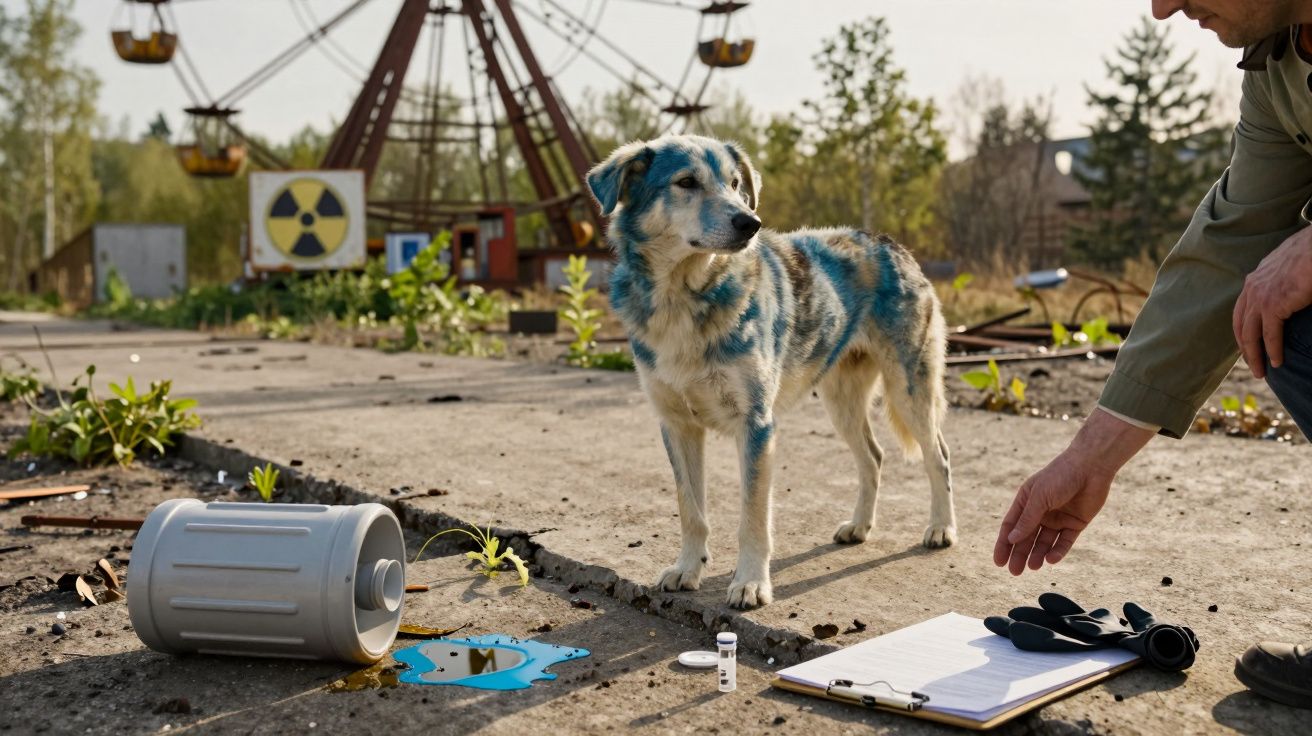
Stray dogs roaming the ruins of Chernobyl already look eerie.
Now, some of them have turned a vivid, unnatural blue.
For researchers working among the silent cooling towers and cracked concrete of northern Ukraine, even small anomalies raise questions. When several semi-feral dogs appeared near the Chernobyl nuclear plant with bright blue coats, cameras came out, Geiger counters stayed close, and a new mystery seemed to unfold.
The Day Glowing Dogs Showed Up at Chernobyl
The Chernobyl disaster in April 1986 transformed an entire region. The explosion of Reactor 4 hurled radioactive material across Ukraine, Belarus, and Russia. A 30-kilometer exclusion zone still surrounds the plant nearly four decades later-largely emptied of human life, but far from empty of wildlife.
Wolves patrol abandoned roads. Wild boar root through cracked asphalt. Horses, birds, and lynx move freely through forests where villages once stood. Stray dogs-descendants of pets left behind during the evacuations-have become a familiar sight around checkpoints and ruined buildings.
These animals live in a landscape saturated with history, fear, and speculation. So when researchers spotted several dogs whose fur appeared startlingly blue near industrial structures on site, the sight cut through the daily routine of fieldwork and vaccination campaigns.
Bright blue fur, a radioactive hot zone, and a long history of secrecy: on social media, those elements almost guaranteed rumors about mutant animals.
Teams from the Dogs of Chernobyl program-a humanitarian and scientific effort that has worked with hundreds of strays in the exclusion zone-photographed the animals and began looking for answers.
Radiation or Chemicals? What Scientists Really Think
The immediate question seemed obvious: did radiation cause the blue color? For researchers used to dealing with public misconceptions about Chernobyl, the suspicion was predictable-but it still needed a clear answer.
Veterinarians examined the animals, checked for signs of skin disease, tested radiation levels, and looked at the pattern of discoloration. Their conclusion pointed in a far more ordinary direction than science-fiction mutations.
How Portable Toilets Ended Up in the Story
According to the Dogs of Chernobyl team, the most likely culprit is a vivid blue chemical used in portable toilets on or near the site. At some point, a unit appears to have broken or leaked, leaving pools or soaked material with concentrated blue fluid.
Stray dogs often treat anything new as a toy or scratching post. Rolling in strong smells is common canine behavior. The animals likely passed through, rolled in, or lay on contaminated ground, coating their fur with the chemical dye.
The blue did not seep out from their skin or blood; it sat on top of the fur like paint on a rough canvas.
Veterinary staff reported that, aside from their bright coats, the dogs behaved normally. They ate, drank, and moved like other strays. Radiation readings did not suggest unusual exposure compared with typical Chernobyl dogs.
There is still some uncertainty about the exact composition of the liquid. Portable toilet additives can contain disinfectants, dyes, surfactants, and perfumes. Many are designed to be low-toxicity at normal concentrations. Problems usually arise when animals ingest large amounts or face repeated exposure.
Health Risks for the Blue Dogs
For these particular animals, the main concern is grooming. Dogs lick their fur to clean it and soothe irritated skin. That habit could transfer chemical residues into their mouths and digestive systems.
According to vets on site, the situation remains manageable as long as the dogs do not repeatedly lick the stained areas or keep seeking out the same contaminated spots. Washing stray dogs inside the exclusion zone is logistically difficult, but researchers can monitor them and reduce their contact with the source when possible.
- Radiation did not cause the blue color of the fur.
- Chemical dye from broken portable toilets remains the leading hypothesis.
- Health checks show the animals are in reasonable condition for free-roaming strays.
- The main risk comes from ingesting or repeatedly contacting the chemical.
Blue Dogs Are Not Unique to Chernobyl
As striking as the photos from Ukraine look, they do not represent a completely new phenomenon. Industrial pollution and discarded chemicals have produced bright blue animals elsewhere.
The Russian Factory Case in Dzerzhinsk
In 2021, residents of Dzerzhinsk-an industrial city east of Moscow-noticed a pack of stray dogs with electric blue fur wandering near an abandoned chemical plant. Photos quickly went viral, and once again talk of mutations and radiation flared online.
Investigations later pointed to dye compounds left at the site of a former factory that once produced chemicals for plastics and other products. According to local authorities, the animals likely rolled in or swam through water contaminated with dye powders.
| Location | Suspected source | Type of exposure |
|---|---|---|
| Chernobyl, Ukraine | Broken portable toilet additive | Rolling in dyed liquid on the ground |
| Dzerzhinsk, Russia | Leftover industrial dye near factory | Contact with contaminated water or soil |
In both cases, the color change drew attention to animals already living in harsh conditions. The blue coats sparked debates about environmental contamination, animal welfare, and how society manages long-forgotten industrial sites.
What the Chernobyl Dogs Can Teach Us
The Dogs of Chernobyl project did not set out to chase viral photos. Its original mission focuses on vaccination, spay/neuter work, and long-term monitoring of stray populations living among the ruins.
Researchers use these animals as a kind of living record of life inside a contaminated but largely rewilded zone. The dogs receive basic veterinary care, deworming, and vaccines against rabies and other diseases. At the same time, they provide blood and tissue samples that help scientists study radiation exposure, genetics, and population dynamics.
Chernobyl’s dogs are both victims of a human disaster and unexpected research partners in understanding how life adapts after catastrophe.
Over the years, studies have begun tracking genetic differences between dogs living near the reactor and those in less contaminated areas of the zone. The work is still early, with many unanswered questions. But it shows how a former Cold War landscape of technology and secrecy has become a long-term laboratory for ecology and evolution.
The sudden appearance of blue coats sits at the intersection of these themes: pollution, adaptation, and the everyday messiness of life in a place shaped by both radiation and regular human activity-from construction to tourism infrastructure.
Radiation Myths and What Actually Happens to Animals
Stories about Chernobyl often lean on images of monstrous wildlife and bizarre mutations. Fieldwork paints a more mixed-and less cinematic-picture.
Radiation can damage DNA, reduce fertility, and increase cancer risk in both humans and animals. Many organisms near highly contaminated areas show higher mutation rates. Some birds and rodents appear to suffer cataracts or reduced brain size. Yet forests have grown back, and many species have returned or even flourished, partly because humans largely left.
Dogs and other mammals living near the plant face overlapping threats:
- Chronic low-level radiation exposure.
- Parasites and infectious diseases due to limited veterinary care.
- Scarce food, harsh winters, and competition with other animals.
- Occasional contact with chemicals and industrial leftovers, such as the blue dye.
Radiation alone does not explain every strange sight around Chernobyl. Leaking toilets, abandoned warehouses, old fuel depots, and construction sites introduce a different kind of risk. Chemicals may act quickly and visibly, while radiation often acts slowly and invisibly.
Why Brightly Colored Animals Matter for Policy
When people around the world share images of neon-tinted dogs, they react viscerally to a visible sign that something has gone wrong. Birds with stained feathers, foxes dyed by factory waste, or dogs with chemically tinted coats can turn an abstract debate about pollution into something concrete and emotional.
For environmental regulators, such cases raise uncomfortable questions. Who cleans up decaying infrastructure inside exclusion zones or around bankrupt industrial plants? How do agencies monitor sites long after companies shut down? The Chernobyl blue dogs highlight that, even in a famous radioactive area, more ordinary chemical waste can still end up in soil and water.
Similar questions surround abandoned mines, military training grounds, and derelict industrial sites in many countries. Animals often become the first visible witnesses when neglected places begin leaking their past into the present.
Looking Ahead: Chernobyl Tourism, Research, and Animal Welfare
Before Russia’s full-scale invasion of Ukraine in 2022, Chernobyl had gradually become a destination for supervised tourism and scientific expeditions. Guides led visitors through ghost towns and forests. Some travelers posted selfies with local dogs, who often learned to approach humans for food.
As access changes with the security situation, attention to animal welfare in the zone may rise and fall. Projects like Dogs of Chernobyl sit at the intersection of humanitarian work and data collection. They vaccinate animals that can act as disease vectors, reduce uncontrolled breeding, and use that contact to collect scientific samples.
For readers far from Ukraine, the story of the blue dogs can be a starting point for a broader reflection. Chemical dyes, disinfectants, and industrial additives rarely make headlines when they remain sealed in containers. Once they leak into broken toilets, cracked floors, or open pits, they begin to color more than the fur of a few strays: they reveal how societies choose to handle long-term waste.
Checking labels at home or following rules for disposing of household chemicals may seem minor. In abandoned industrial zones, the same principles scale up. Safer storage, better monitoring, and clearer responsibility can reduce the chance that the next viral animal image points not to a mystery of nature, but to another preventable spill.






Comments
No comments yet. Be the first to comment!
Leave a Comment