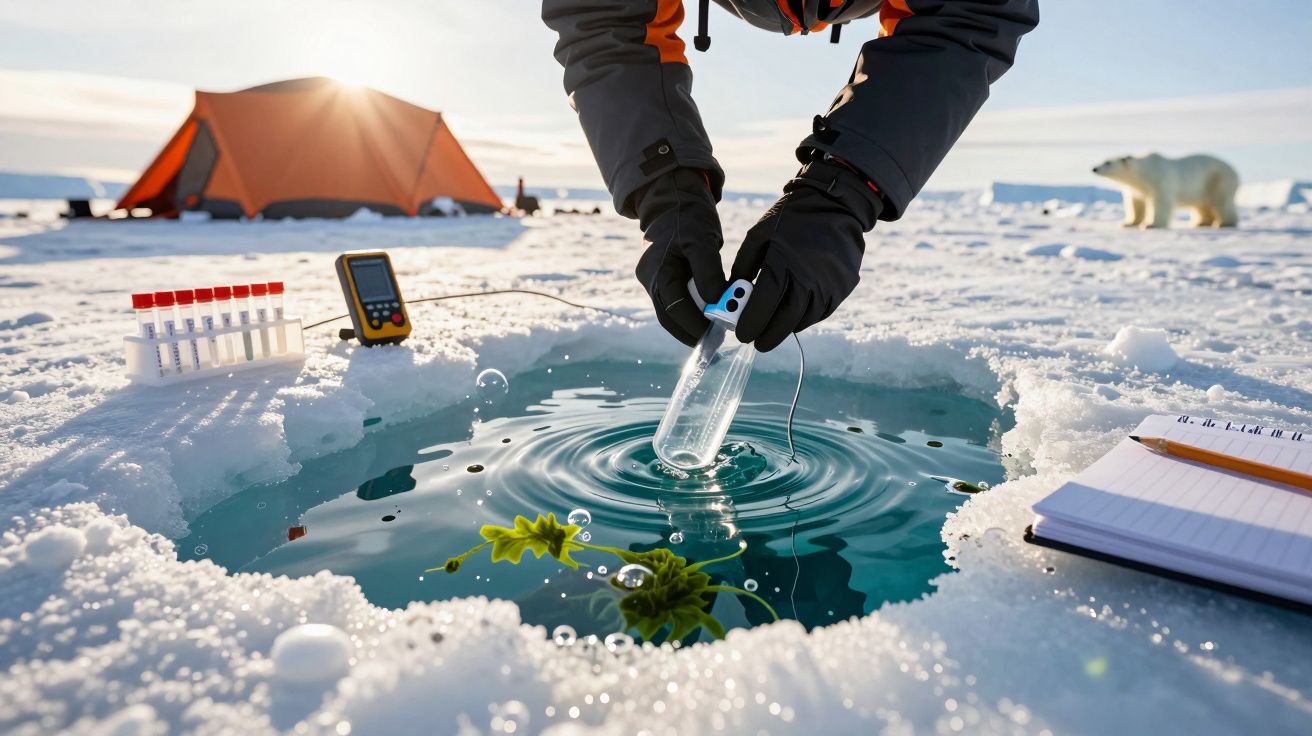
Beneath the Arctic’s silent ice, an unexpected biological engine is stirring-quietly redrawing the map of our changing climate.
For years, scientists treated the frozen ocean as a passive victim of warming seas. Now, unusual microbes under the ice are turning that idea upside down.
Under the ice, an invisible nitrogen factory switches on
The central Arctic Ocean has long had a reputation as a biological desert. Thick sea ice, little sunlight, and frigid waters seemed to rule out any sustained productivity. Research teams typically focused on the edges of the pack ice, where seasonal melt creates patches of open water.
That view is starting to crack. As sea ice thins and retreats, researchers are detecting microbial communities that do something once thought almost impossible in polar waters: they fix atmospheric nitrogen.
These organisms, known as diazotrophs, pull nitrogen gas (N₂) dissolved in seawater and convert it into ammonium. That ammonium then feeds microscopic algae, which form the foundation of the Arctic food web.
Under the Arctic ice, nitrogen-fixing microbes appear to turn a supposedly barren ocean into a quiet engine of productivity.
Until recently, scientists believed this kind of activity belonged mostly to warm, sunlit tropical waters. But sampling campaigns using research icebreakers such as Polarstern and Oden have revealed a different picture. Teams detected active nitrogen fixation under multi-year ice in the Eurasian Basin, in waters that receive little light for most of the year.
Genetic and chemical analyses suggest much of this work comes from non-cyanobacterial bacteria, a group that thrives in cold, dark conditions. Unlike the classic cyanobacteria that dominate nitrogen fixation in tropical oceans, these microbes do not rely on photosynthesis. Instead, they draw on organic matter drifting under the ice, reshaping how nutrients circulate in what was once considered a marginal sea.
How Arctic nitrogen feeds a growing carbon sink
Measured rates of nitrogen fixation in the central Arctic now reach up to several nanomoles of nitrogen per liter per day. That sounds tiny, but across vast stretches of ocean and over months, it adds up.
Each molecule of newly fixed nitrogen can support additional algal growth. Those microscopic algae take in carbon dioxide from the atmosphere through photosynthesis. When they die, part of their carbon-rich biomass sinks into deeper waters-or all the way to the seafloor-where it can remain stored for decades to centuries.
More nitrogen means more algae, more carbon pulled from the air, and potentially more carbon buried in the deep ocean.
This chain reaction shapes what scientists call the biological carbon pump. In the Arctic, that pump already plays a subtle but strategically important role in the global carbon budget. The emerging nitrogen source under the ice could strengthen it, turning the region into a more active-though fragile-carbon sink.
The food web effect: from microbes to polar bears
Extra nitrogen does more than change numbers in climate models. It ripples through the entire Arctic ecosystem. When algal productivity increases, small grazers such as copepods and krill have more to eat. They, in turn, nourish fish, seabirds, and marine mammals.
- Microbes fix nitrogen and stimulate algal growth.
- Algae fuel zooplankton like copepods and krill.
- Zooplankton support fish, seabirds, and marine mammals.
- Top predators, including seals and polar bears, depend indirectly on this base.
That means subtle changes in microbial activity under the ice can influence where fish migrate, where whales feed, and how seabird colonies fare during the short Arctic summer. The climate story and the biodiversity story are tightly intertwined.
A climate “weapon” with sharp edges
Calling these microbes a “weapon” against global warming captures only part of the picture. Their activity might help lock away more carbon, but it also comes with risks and feedback loops.
| Process | Potential climate effect |
|---|---|
| Increased nitrogen fixation | Boosts algal growth and carbon uptake |
| Enhanced organic matter supply | Stimulates bacterial respiration and CO₂ release |
| Stratification from ice melt | Can trap nutrients near the surface, but also limit deeper mixing |
| Expansion of open water | Increases ocean heat absorption and accelerates ice loss |
As summer sea ice shrinks, more sunlight penetrates the surface ocean. That can trigger algal blooms, especially where nitrogen-fixing microbes are already active in the background. At the same time, warmer, fresher surface waters stratify the ocean, forming distinct layers. Stratification can keep nutrients near the surface but also restrict the upward flow of deeper nutrients later in the season.
There is another twist. When bacteria break down the extra organic matter produced by algal blooms, they consume oxygen and release carbon dioxide. In enclosed or weakly ventilated layers, this can locally offset some of the carbon captured earlier. In some cases, microbes also generate nitrous oxide, a potent greenhouse gas-although current Arctic measurements are limited and uncertain.
Why climate models need to catch up
Global climate models still treat the central Arctic as a place with minimal nitrogen fixation. That assumption now looks shaky. If these microbes provide a meaningful share of the region’s nitrogen supply, then estimates of Arctic primary productivity-and carbon uptake-could be off by a wide margin.
Ignoring under-ice nitrogen fixation risks underestimating how quickly, and in what way, the Arctic responds to warming.
Updating models is not just a technical exercise. Policy decisions on emissions targets, fisheries management, and Arctic shipping all rely on projections rooted in those simulations. If the Arctic absorbs more carbon than expected for a few decades, some scenarios might temporarily look less alarming than they should. If that sink later weakens or flips due to changing stratification or gas emissions, the surprise could be severe.
A moving target for future research
Researchers are now pushing for year-round measurements under the ice, using autonomous floats, moored instruments, and under-ice drones. They want to track how nitrogen fixation varies with season, ice thickness, meltwater input, and shifting circulation patterns.
Several open questions are guiding this new wave of work:
- How large is the total nitrogen budget linked to Arctic diazotrophs?
- Does nitrogen fixation peak near retreating ice edges, or under thick multi-year ice?
- How will continued warming and freshening shift microbial communities and their metabolic pathways?
- Could future Arctic conditions favor species that emit more nitrous oxide?
Simulations that couple ocean physics, microbial ecology, and biogeochemistry are now testing different futures. In some scenarios, the Arctic strengthens its role as a carbon sink for several decades before stabilizing. In others, accelerated stratification and shifts in species composition reduce deep carbon export, limiting any offset to human emissions.
Beyond nitrogen: what else hides under the Arctic ice
The story of nitrogen-fixing microbes points to a broader message: scientists likely still underestimate Arctic biodiversity at microscopic scales. Under the ice, communities of bacteria, archaea, and tiny algae live along gradients of light, salinity, and nutrients that can change meter by meter.
These organisms do more than manage nitrogen. They recycle phosphorus and silica, transform organic carbon into dissolved forms that can travel across ocean basins, and produce compounds that influence cloud formation above the ice. A small shift in their composition could, in theory, alter regional weather patterns or the timing of sea ice formation.
There is also a geopolitical dimension. As new shipping routes open and resource extraction intensifies, human activity may bring pollution and invasive species into waters that host these delicate microbial engines. Oil spills, black carbon from ships, and altered nutrient inputs from coastal runoff could push this emerging nitrogen “weapon” to behave in ways current models do not anticipate.
For anyone tracking climate risk, the awakening of Arctic nitrogen fixation is a reminder: the planet’s response to greenhouse gases does not play out only through melting ice and rising seas. It also unfolds through hidden metabolisms in the darkness beneath the ice, where microscopic workers quietly adjust the balance among carbon, nitrogen, and life itself.





Comments
No comments yet. Be the first to comment!
Leave a Comment