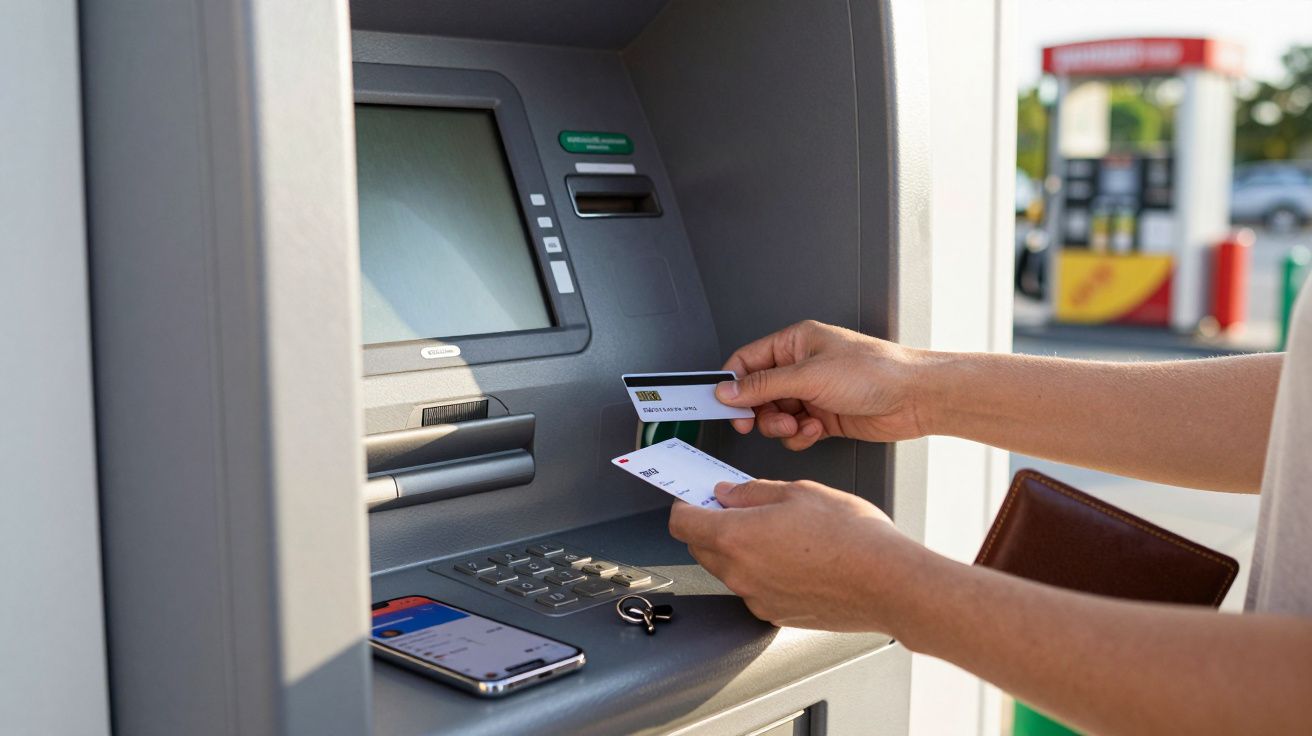
That routine cash withdrawal at the corner ATM might hide a quiet risk, especially when you’re in a rush and distracted.
Across Europe and North America, police and banks are warning about a rise in card cloning at ATMs, where criminals can copy both your card and your PIN in seconds. A quick, almost automatic move before you insert your card can often stop the scam before it starts.
The hidden threat waiting in the card slot
Most people blame the machine when their card gets rejected or an ATM acts strangely-a glitch, a network error, nothing to worry about. But those “technical problems” can sometimes be a sign of something very physical: someone has tampered with the machine.
This method, known as skimming, uses small devices placed over or inside the real card slot. They read your card’s magnetic stripe while a separate tool captures your PIN. You walk away thinking the transaction failed, while your data goes straight to a fraudster.
Skimming rarely looks like a Hollywood hacking scene. It’s usually a piece of cheap plastic, slightly crooked, waiting for the next distracted customer.
Criminals then encode your copied data onto a blank card. With your PIN recorded, they can withdraw cash from machines that still accept magnetic-stripe transactions-often in another country where controls are weaker or slower to react.
Why ATMs and gas stations get targeted
Skimming doesn’t only happen at ATMs. Self-service gas pumps, unattended payment terminals in parking garages, and ticket machines can also be targets. Anywhere you insert a physical card and enter a PIN can be vulnerable.
- ATMs on quiet streets or in poorly lit areas
- Cash machines inside small shops without constant staff presence
- Gas pumps far from the cashier’s direct view
- Older payment terminals that haven’t been upgraded recently
These locations give criminals time to install and remove fake devices without drawing attention. They may pose as technicians, or show up late at night when cameras and staff aren’t watching closely.
The one move that blocks most skimming attempts
Security experts repeat the same advice, and it takes less than five seconds: before you insert your card, grab the card slot and the keypad area and try to move them.
Pull, push, wiggle: if anything feels loose, misaligned, or like an extra layer, do not insert your card.
This simple check often reveals skimming devices because they sit on top of the real hardware. They usually can’t be installed perfectly in a hurry. Many look slightly thicker than normal or have a different texture or color.
What you should look and feel for
Your first line of defense is a quick visual and physical inspection. You don’t need technical skills-just attention.
Ask yourself these questions while standing in front of the ATM:
- Does the card slot look bulkier than usual or a different color than the rest of the machine?
- Is there a plastic frame or ring around the slot that seems removable?
- Does the keypad surface look thicker, crooked, or slightly raised?
- Are there visible glue marks, tape, or small gaps around the slot or keypad?
- Can you move the slot or keypad slightly when you tug it? Real parts are firmly fixed.
If anything feels off, stop the transaction, step away, and if possible alert the bank or the business hosting the machine.
Shielding your PIN: a small move with a big impact
Even if criminals fail to read your card, they may still try to steal your PIN using a tiny camera or a fake keypad placed over the real one. Another simple habit helps: always cover the keypad when you enter your PIN.
Use your free hand, your wallet, or even your phone as a shield so no lens can see your fingers.
Hidden cameras are often placed at eye level-above the screen, inside a panel, or in a fake brochure holder attached near the machine. Since you may not notice them, blocking the line of sight is the most reliable habit.
Why “simple” PINs cost people money
Fraud teams keep seeing the same weak PINs in compromised accounts: birth dates, 1234, 0000, 2580 (straight down the keypad), or repeated digits. Criminals know this and try those combinations first when testing a cloned card.
Choosing a less obvious PIN and changing it regularly reduces the risk that they can guess it if their camera failed or the footage is unclear. A four-digit code limits the number of combinations, so avoiding “easy” ones makes their job harder.
| Risky PIN choices | Safer habits |
|---|---|
| Birthdays and anniversaries | Random digits not tied to personal data |
| 1234, 0000, 1111, 9999 | A non-repeating mix of numbers |
| Simple patterns (2580, 1212) | Change codes every few months |
Using safer machines and smarter digital tools
Not all ATMs carry the same level of risk. Fraud specialists generally recommend using machines attached directly to bank branches or located inside well-monitored areas such as busy shopping centers.
These places usually have better lighting, more cameras, and staff who may notice tampering. Standalone ATMs in late-night bars, gas stations along highways, or random corners of convenience stores tend to have less supervision.
When you have a choice, walk the extra minute to the bank’s own machine rather than the lone ATM at the edge of the parking lot.
Digital alerts add another layer of protection. Most banks now let you set up instant notifications by text or email for every card transaction. This can reveal fraudulent payments or cash withdrawals within minutes.
What to do if something looks or feels wrong
If the ATM behaves oddly-taking a long time to respond, rejecting your PIN repeatedly, or keeping your card-act cautiously.
- Cancel the transaction and press Cancel repeatedly.
- If your card doesn’t come back, stay by the machine and call your bank using the number in your banking app or statement (not a number printed on the ATM).
- Check your recent transactions as soon as possible through online banking.
- Report any suspicious device, damage, or behavior to the bank or the store owner.
Reporting quickly gives banks a chance to disable the machine and limit additional victims. It also strengthens any claim you may need to file later.
Watching your account like a journalist tracks a story
ATM scams rarely happen just once. After criminals confirm your card works, they often move quickly before you or the bank reacts. That makes regular monitoring of your balance and transaction history essential.
Make it a weekly habit: scroll through your account activity and stop at each unfamiliar charge, even small ones. Fraudsters sometimes start with low-value test transactions to confirm the card works before attempting larger withdrawals.
A strange £1 payment can be more alarming than a visible £100, because it signals a quiet rehearsal before a larger hit.
If something doesn’t match your memory, contact your bank immediately. In many countries, consumer protection rules require banks to refund unauthorized transactions when you report them quickly and didn’t handle your PIN carelessly.
Why these scams persist despite chip cards
Many people assume chip-and-PIN technology solved card cloning. While chips do add protection, magnetic stripes still exist on most cards, especially for use abroad. Criminals exploit that compromise.
Skimming usually copies magnetic-stripe data, not the chip. Fraudsters then use the cloned card in regions or machines that still rely on the stripe. Banks try to detect these patterns-for example, a U.K. card suddenly used at an ATM on another continent-but some transactions go through before systems react.
That tension between convenience and security is why small human habits still matter. Technology improves, but scams adapt, and the card slot remains a physical point of contact criminals can manipulate.
Turning a boring routine into a safety ritual
Most of us treat cash withdrawals as background tasks-something we do while thinking about the next meeting or what to make for dinner. But adding a few deliberate steps barely slows you down and significantly reduces risk.
Before you insert your card into any machine, ask yourself three quick questions: Does this ATM look normal? Does anything move when I tug it? Can anyone-or anything-see my PIN? If any answer concerns you, walk away and use another terminal, or pay by phone or contactless instead.
Skimming thrives on distraction and routine. A firm pull on the card slot, a hand covering the keypad, and a quick check of your account later in the day can turn you from an easy target into a much harder one.





Comments
No comments yet. Be the first to comment!
Leave a Comment